
Quick Start Guide
This section offers a concise quick start guide for the BioDryer. It's designed to provide a straightforward overview of the operations, allowing you to grasp the essential processes without delving into extensive details. Use this as your initial roadmap to understanding and operating the BioDryer efficiently.
This Quick Start Guide includes example numbers, such as the amount of biosolids loaded or the type of cycle used. While these figures represent standard settings for the BioDryer, you may need to adjust these numbers based on your specific operational requirements. Consider this guide as a foundational reference, adaptable to your particular context.
Prerequisites for Operating the BioDryer
Before initiating the BioDryer, ensure:
- Around 3000kg of dry biosolids is present in the BioDryer. If not, perform the startup procedure until this amount is achieved.
- All utilities are connected and properly sized.
- The dewatering system is ready to feed biosolids into the BioDryer.
- The dry solid discharge system is functioning correctly.
Process setup
Open the settings panel (see the Process Setup Page if you are not familiar) and enter the following setup paramentes in the settings page:
- Auto-Load after Unload: NOT-ACTIVE
- Auto-Cycle after Load: ACTIVE
- Auto-Unload after Cycle: NOT-ACTIVE
- Rotation Frequency: 4
- Weight Distribution to Front: 50%
- BioCycle Mode: STANDARD_MODE for energy efficiency or STANDARD for faster processing.
- Dry Content Goal: 80%
- Load goal weight: 9,000 kg
- Unload goal weight: 3,000 kg
- Discharge Gate Opening: 30%.
- Discharge Interval: 10 seconds
- Openings Before Rotation: 10 openings
Start the BioDryer
Load
After configuring the parameters in the previous section, starting the BioDryer is a straightforward process:
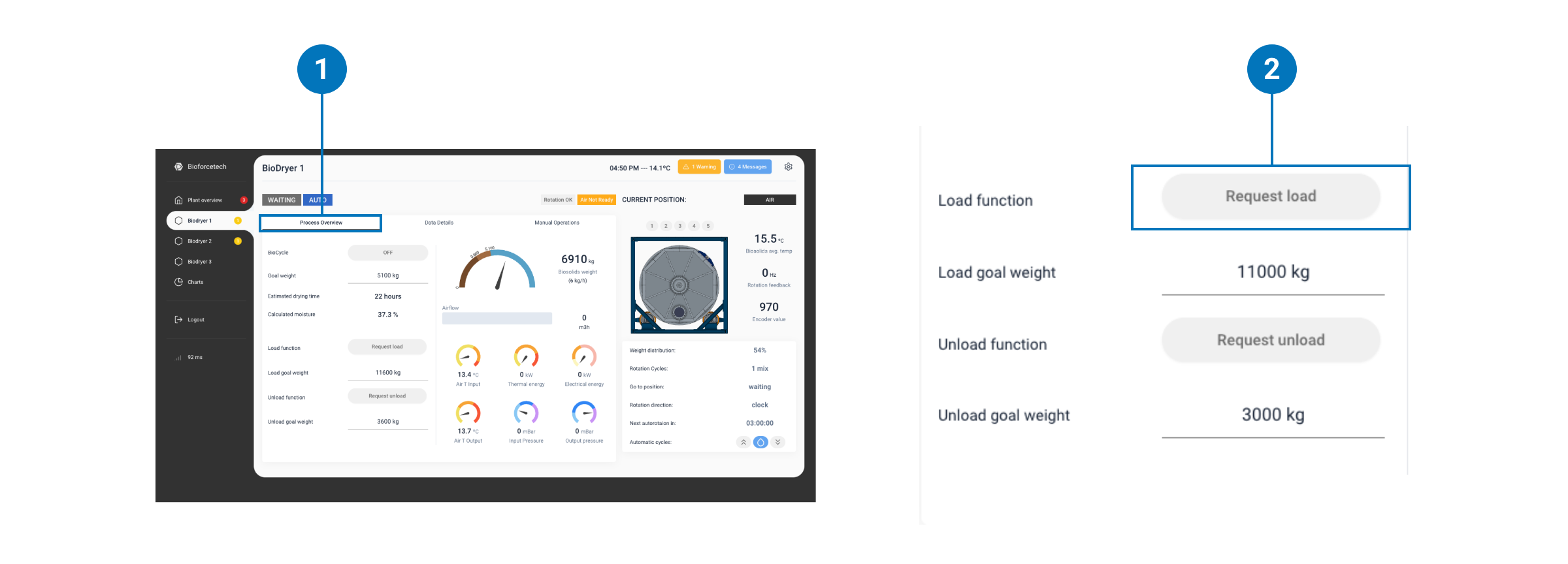
- Navigate to the Process Overview tab in the HMI interface.
- Click on Request Load to initiate the process.
Drying Process
Once you've done this, the BioDryer will automatically move into the load position and signal the dewatering system to supply biosolids. The system will continuously monitor the internal weight, and as soon as it reaches the pre-set goal of 9000 kg, the BioDryer will transition into the drying cycle automatically. This seamless integration ensures a smooth start to the drying process, aligning perfectly with your pre-configured settings for an efficient operation.
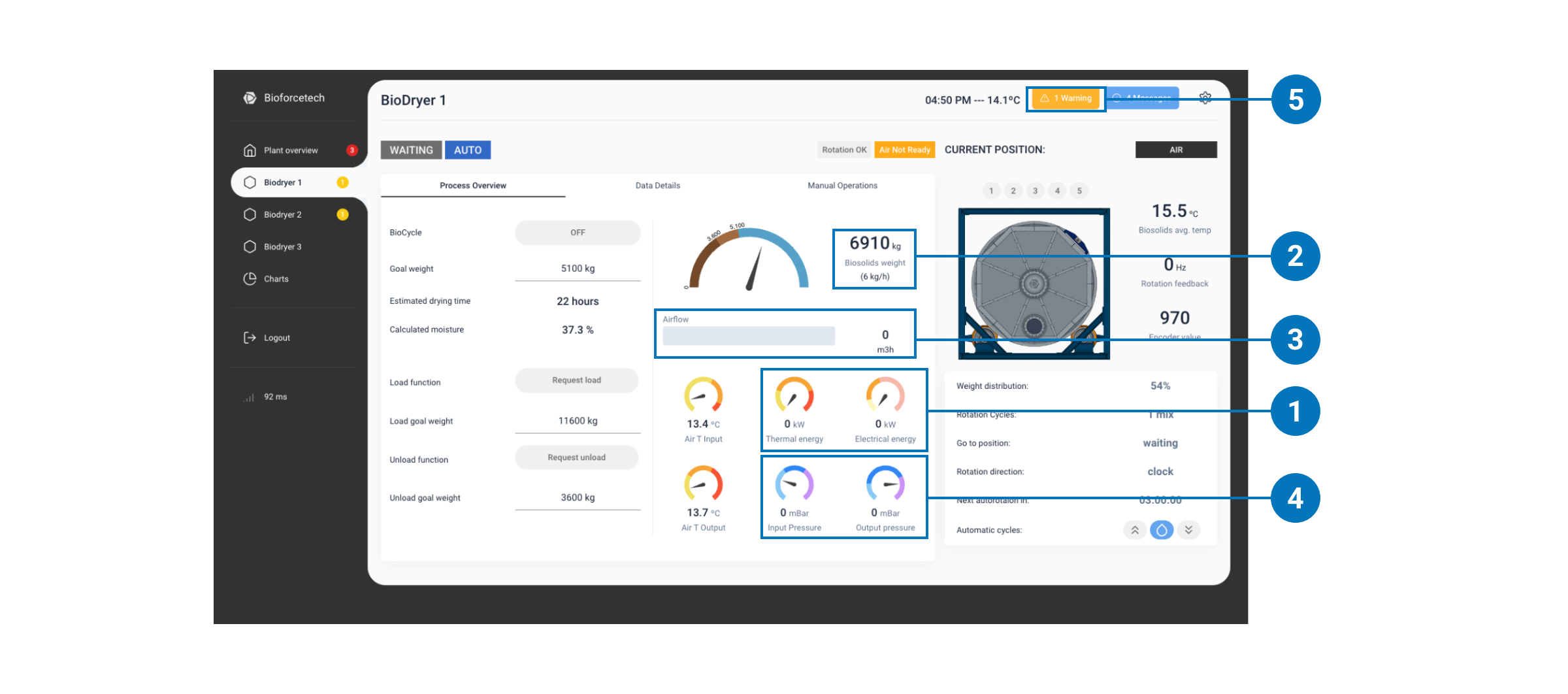
While the BioDryer operates automatically, it's suggested to periodically check certain parameters to ensure optimal environmental conditions and performance throughout the drying process. Here's what you need to monitor in the Process Overiview page:
-
Energy Consumption: Verify that the input of electrical and thermal energy remains within the designated orange line. This ensures that the system is not consuming more energy than expected.
-
Drying Speed: After 3 to 4 hours into the process, the rate of weight loss (kg/h) should exceed 80kg/h. A lower rate may indicate a slower drying speed, necessitating adjustments.
-
Airflow: The airflow rate should be maintained between 3000 and 4000 m³/h. Proper airflow is crucial for efficient drying and maintaining the desired temperature and humidity levels.
-
Pressure Levels: Ensure that the inlet pressure is always positive and does not surpass 15mBar. Conversely, the output pressure should be maintained at a minimum of -2mBar. These pressure levels help in preserving the integrity of the system and ensuring effective drying.
-
Warnings and Alarms: Stay alert for any warnings or alarms that may arise during the process. Should any occur, promptly refer to the "Troubleshooting" section of this manual. There, you'll find a comprehensive list of potential alarms along with guidance on how to address them.
Regularly monitoring these parameters will help in maintaining the efficiency of the BioDryer, ensuring a successful drying process, and prolonging the lifespan of the system.
Unload
After the BioDryer reaches the process goal weight, it automatically transitions into the next phase. The system rotates into the unload position and sends a request to the automation system to activate the unload conveyors, marking the beginning of the unloading process. Once clearance for unloading is granted, the BioDryer initiates the discharge of dried biosolids. Continuously monitored to ensure precision, the unloading continues until the unload goal weight of 3000 kg is met. This automated and seamless progression from the drying to unloading stages exemplifies the efficient operation cycle of the BioDryer.